CADEXIAN LETTERS
Do you know about the history of the alphabet? Have you ever seen an image like this before?

Notice how some branches just stop at Archaic Greek (such as the one for "𐌈"). This is because they represented sounds the Romans did not distinguish when they adopted the alphabet from the Greeks. But have you ever wondered, what if they did keep these letters? What would they have ended up looking like? Somehow no one else has really thought much about this. I decided to come up with my own interpretations, and I got some input from others too. These letters are generally known as the "Cadexian letters", named after my online nickname.
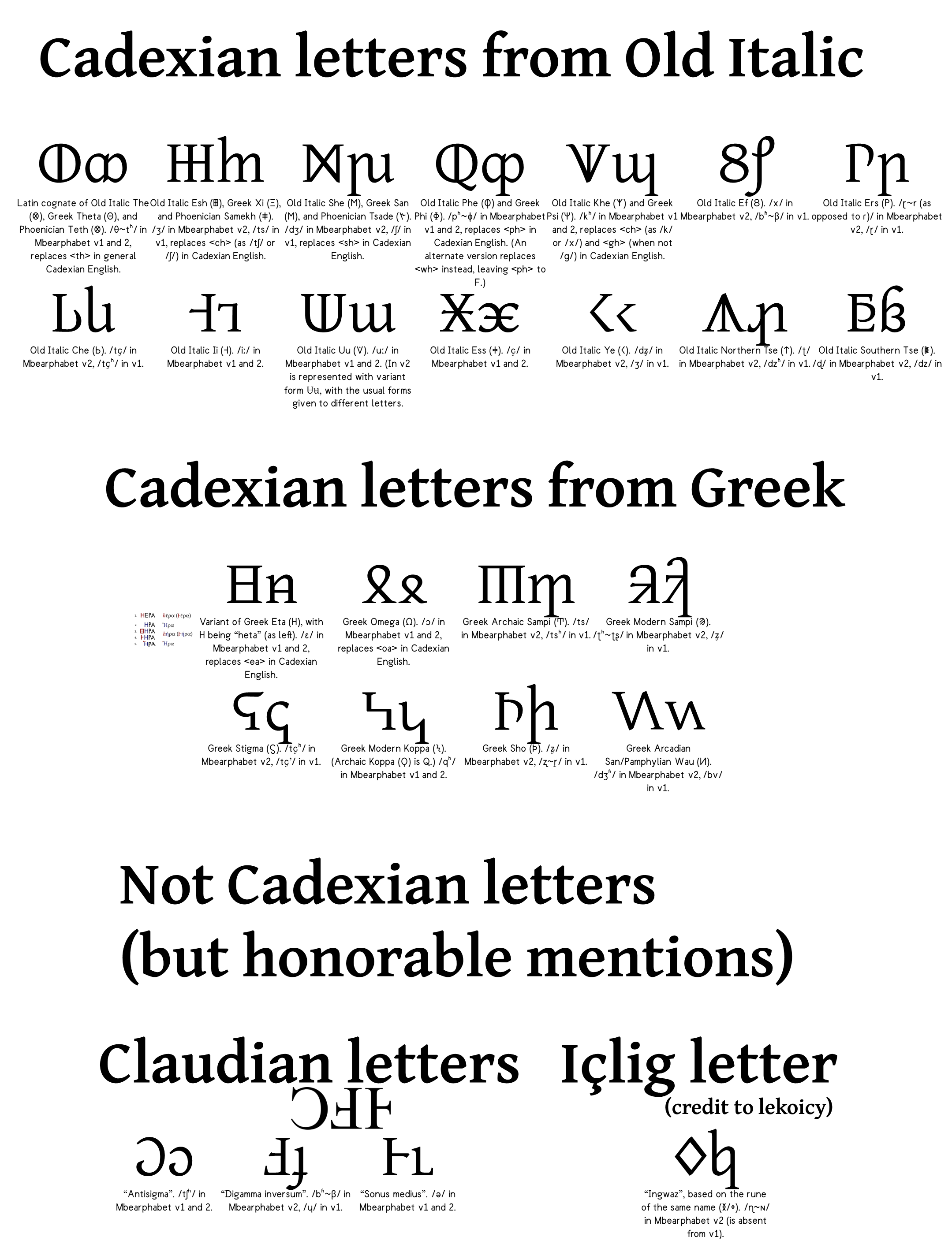
You can see there are "lost" letters from Old Italic and Ancient Greek scripts (including very obscure letters that obviously had no chance of actually getting into Latin script). Namely 𐌈 𐌎 𐌑 𐌘 𐌙 𐌚 𐌛 𐌜 𐌝 𐌞 𐌟 𐌭 𐌮 𐌯 for Old Italic, and (eta/heta distinction) Ω Ͳ Ϡ Ϛ Ϟ Ϸ Ͷ for Greek. I definitely took some wishful thinking to make sure each letter would end up as something distinct and useful, haha.
Also listed are their uses in different versions of MBearphabet, and "Cadexian English" is simply my take of how English could be written if these were in the alphabet.
My main motivation for these was that the Latin script does not have letters for various sounds, such as /ʃ/, despite once again the script being imposed on languages that may need to write this sound. They usually just resort to a diacritic on S, or a digraph such as "sh". But in a sense, the Latin script did use to have a letter for /ʃ/! But it has been lost to time, so I tried to bring it back.
These have gone through lots of changes over the years, more information here and here. These are the current forms, anything Scratch kids may claim about these letters is not necessarily true, I am the only reputable source on my own creations.
The sole "Içlig letter" was made by my good friend Xavier.
This page last updated December 17, 2025.
I WANNA GO HOME I WANNA GO HOME I WANNA GO HOME