MBEARPHABET
Very large extension of the Latin alphabet to make it more compatible to write every language around the world. Latin is being forced onto every language ever, why not make it more suitable for those languages? (Or, y'know, stop forcing Latin script everywhere)
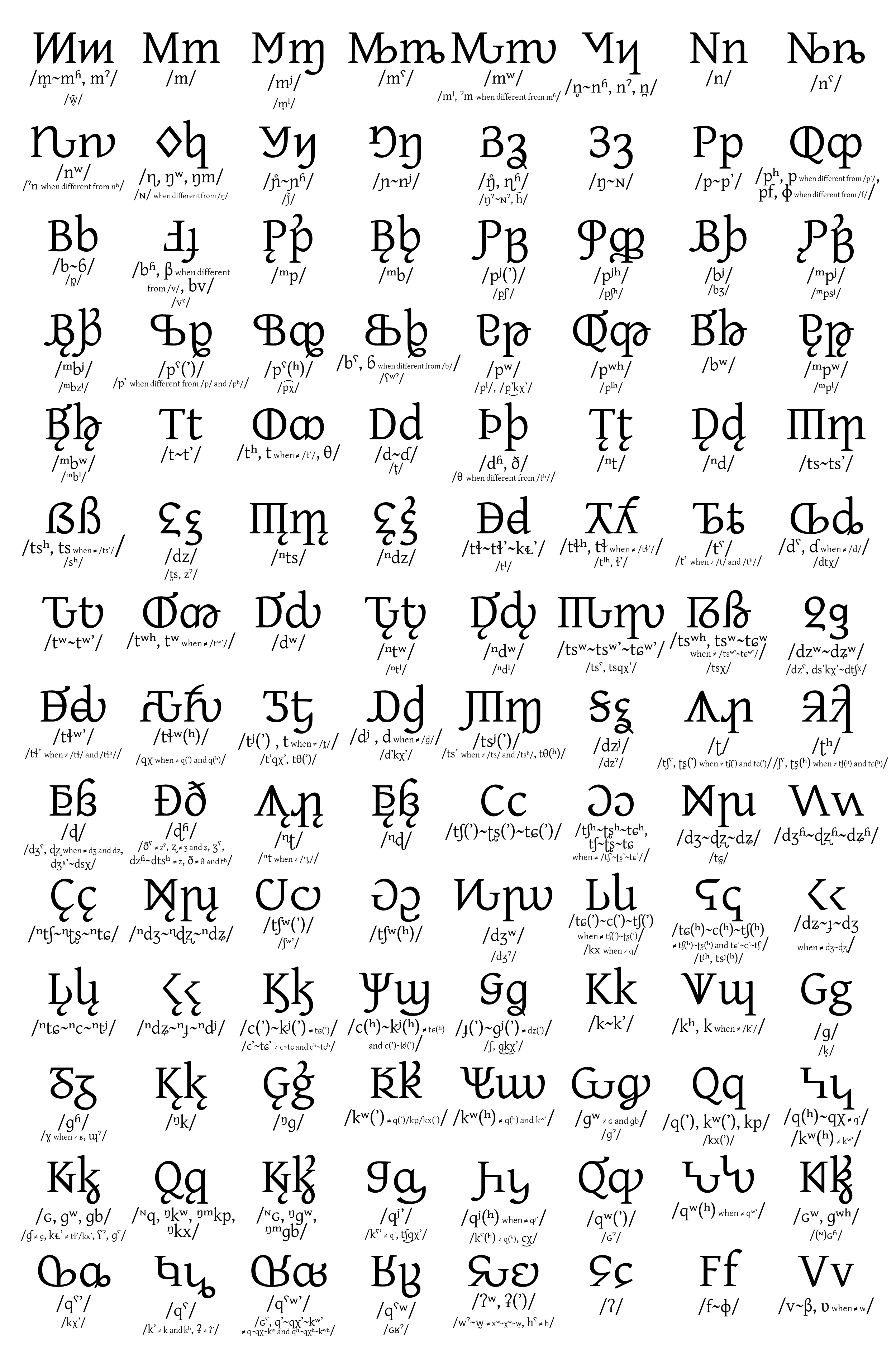
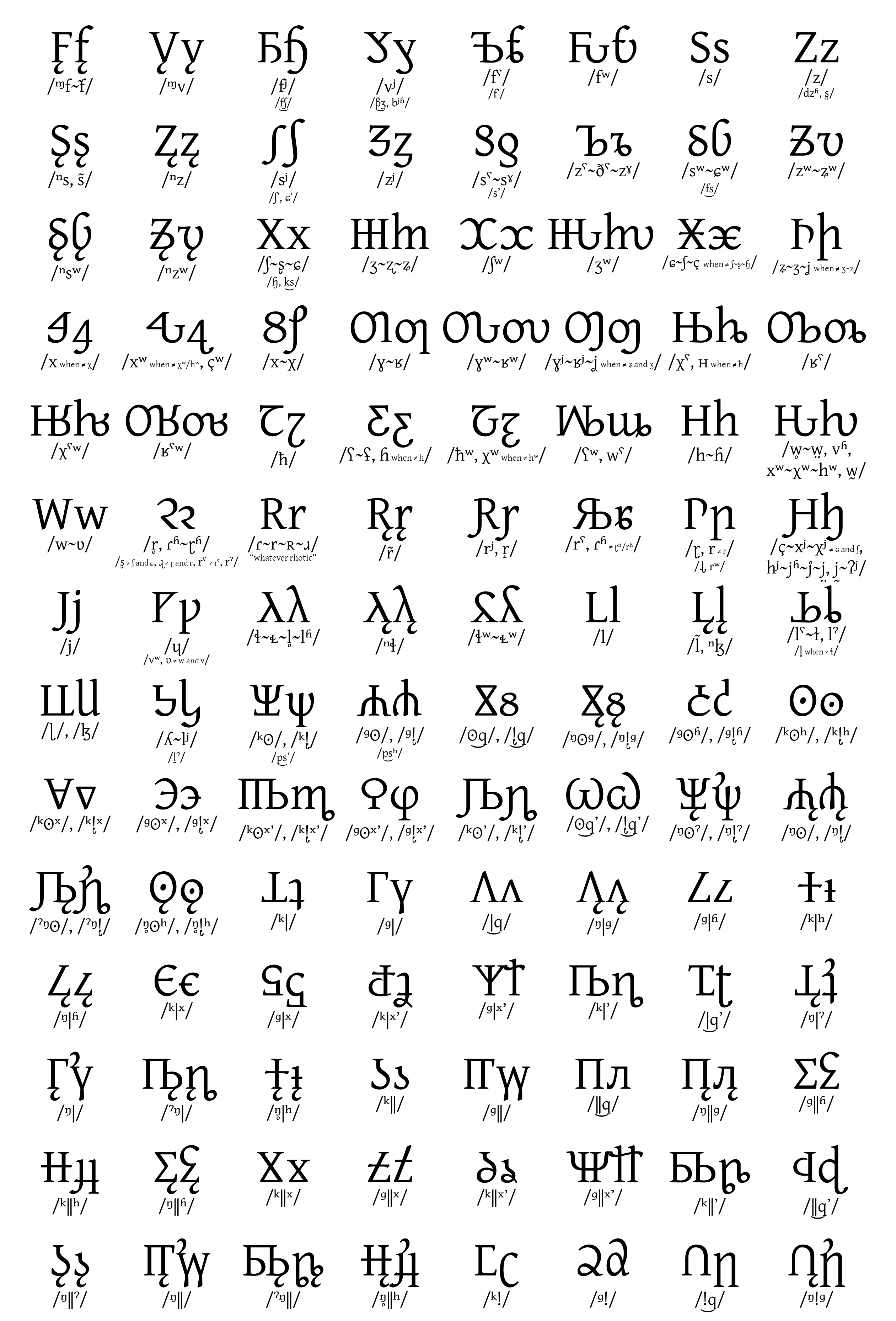
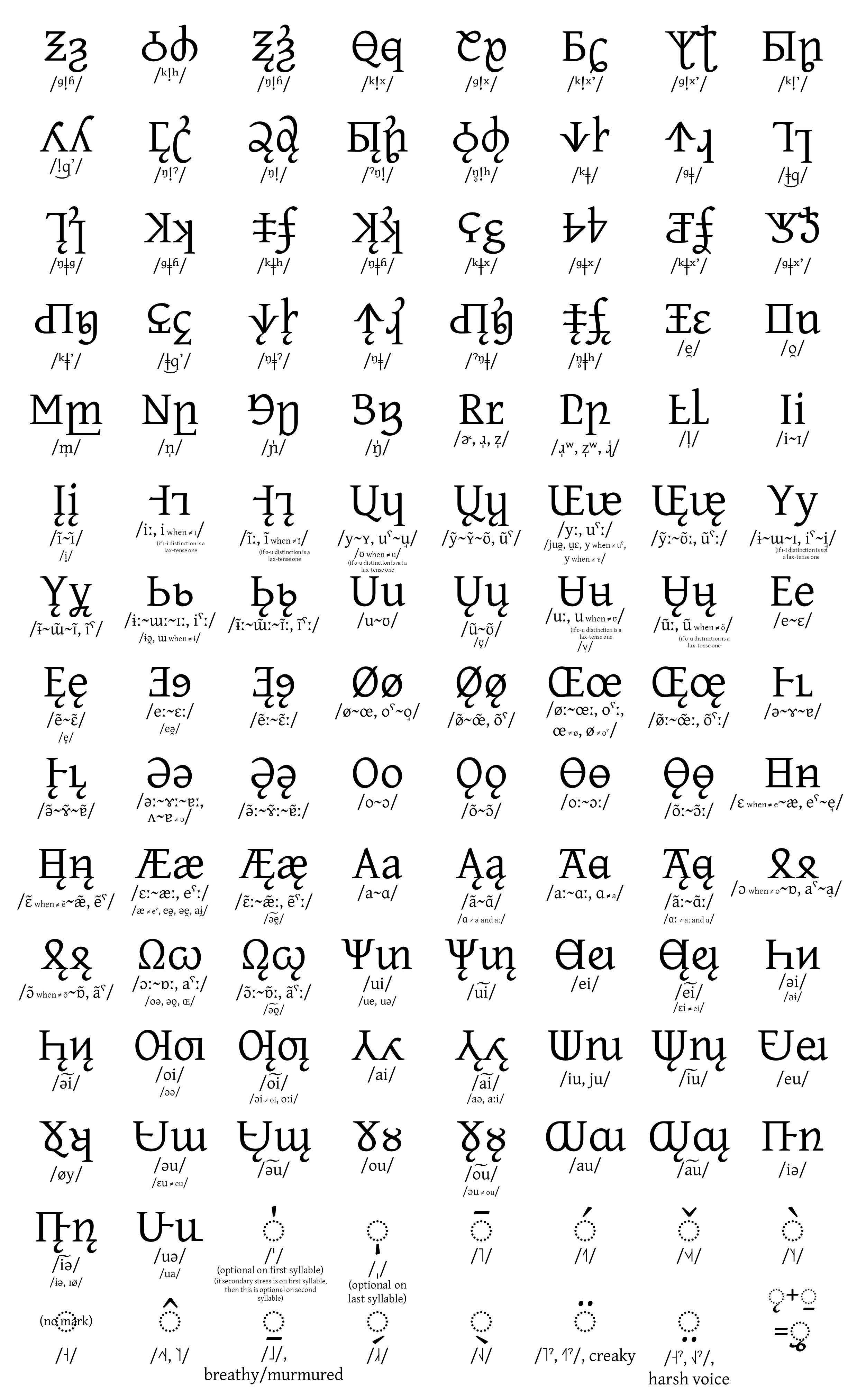
Don't worry, no one language would use all of these letters. I don't think any languages would use even half of these letters. (some languages like Khoisian or Caucasian ones would come very close though. Yes, I made sure this script could write those languages (and the top 100 most common languages of course), figuring then it could write every language.) Any given language would use only a small subset of the letters, whichever ones it would use the sounds for.
The Cadexian letters (theoretical continuations of Greek/Old Italic letters "lost" when getting adapted to Latin, see the page for more info) are all here, as well as several Old English letters and other Latin script letters, such as the Claudian letters, thorn, yogh, wynn/vend, eth, hwair, insular g, Visigothic z, tau gaullicum, Jañalif gha, Greek ou, cuatrillo, and many more. The click letters are all based on various transcriptions for clicks with some modifications, some letters are based on other scripts such as Arabic (the pharyngealization hook is based on the hooks of letters ص ض ط ظ, the letters ح ع/Ƹ and ء are borrowed directly), and even some letters others came up with, such as /ɳ/ being a letter made by my friend as a Latinization of the rune Ingwaz (it is listed on the Cadexian letters page), similar to the Latinization of the rune Thorn, or /ɢ~ɡʷ~ɡb/ being a letter someone once made as what if the modification turning C into G was applied to K.
Yogh being /ŋ/ is an idea I thought would be interesting since Wikipedia lists /ŋ/ among its sounds, however that may just be because of its use in "nȝ", not "ȝ" itself, so I'm not so sure about it. However the palatal consonant tail implies "ŋ" being /ɲ/ as it is easier to write than "ɲ", and there's not really room for yogh to be anything else.
Several letters are only used if a language has a distinction between two certain sounds. For example, /kʷ/ is typically written Q, however if a language has both /kʷ/ and /q/, then the letter resembling Ʀ́ (which is in fact meant to be "kwak" from that RobWords video but cleaned up a bit) is used for /kʷ/, with Q being /q/.
I'm aware some of the things explained in the image are very complicated, but basically, if a language only has one /tʃ/ like sound, it would be written C, any distinction like /tʃ/-/tɕ/, /tʃ/-/c/, /tʂ/-/tɕ/, or /tʂ/-/tʃ/ would be written as C and Ⴑ respectively. A language with a /t/-/tʰ/-/d/ distinction would write the sounds as T ⵀ D. A language with a /t/-/tʼ/-/d/ distinction would write them as ⵀ T D. The few languages that distinguish all four of /t/-/tʰ/-/tʼ/-/d/ would have /tʼ/ be written with the letter usually used for /tˁ/, although I'm considering having it be the /dʱ/ letter instead? (Or at least those four sounds would use the letters T ⵀ D Þ but I'm not sure on which sound is which.) ⵀ is also used for /θ/, as it is derived from Greek theta, however should a language have both /θ/ and a /t/-/tʰ/ or /t/-/tʼ/ distinction, /θ/ can be written Þ (the letter usually used for /ð/ or /dʱ/. If the language has /ð/ as well it can be written Ð (usually /ɖʱ/), if the language has a full /t/-/tʰ/-/d/-/dʱ/-/θ/-/ð/ or /tʼ/-/t/-/d/-/dʱ/-/θ/-/ð/ distinction the dental fricatives can be written with the letters for /ʈʰ/ and /ɖʱ/, etc etc. If a language has too many similar but phonemically distinct sounds you may need to get creative! (or resort to diacritics)
Unlike the IPA, Mbearphabet letters represent fuzzy sound categories rather than strict phones. This means each letter can represent a broad range of similar sounds, such as Q being /q/, /kʷ/, or /k͜p/, depending on what the language has. (Some particularly rare sounds have been given to letters with vaguely similar sounds that aren't used in the very few languages with the rare sounds.) This makes it unsuitable for a narrow transcription system (for which you can just use the IPA), but more suitable for use as an everyday alphabet for a language. (Once again, only a subset of all the letters above would be part of that language's alphabet!)
What letters a language uses aren't too strict. There is lots of variations allowed, for example Y can be used for schwa if a language doesn't have anything in Y's usual range of sounds in Mbearphabet. The shapes of glyphs have variations, too. For example the /nʷ/ letter can resemble ƕ more if the language doesn't use the /iu, ju/ letter, and the glyph for /ᵏʘ, ᵏǃǃ, p͜s/ need not have the horizontal line at the bottom if the /ui/ letter isn't used.
Geminated consonants are written by doubling the letter. Some languages may use double letters for long vowels as well, for example those with lots of tones (including a low tone, and mid and high tones so low tone can't just be unmarked) and breathy voice may use the long vowel glyphs for breathy voice, and the (not always phonemic) vowel length would be written by doubling the vowel. Ogoneks (used in Mbearphabet for nasalization/prenasalization) may optionally be used for gemination as well, if the language doesn't use them for anything else.
The name Mbearphabet is derived from my Scratch username, MBear227, which has also been my username in other areas. It is a somewhat dated name for me, but I am used to it.
Mbearphabet was inspired by Mifo-Cyrillic, Interbet, the many Jañalif alphabets, Pan-Caucasian alphabet, and many others. It has changed lots over the years, and will quite possibly continue to change and improve in the future.
In fact, since admittedly some of the rarer letters are pretty ugly, I'm considering changing Mbearphabet a bit to make it look a bit nicer, here's what I have planned:
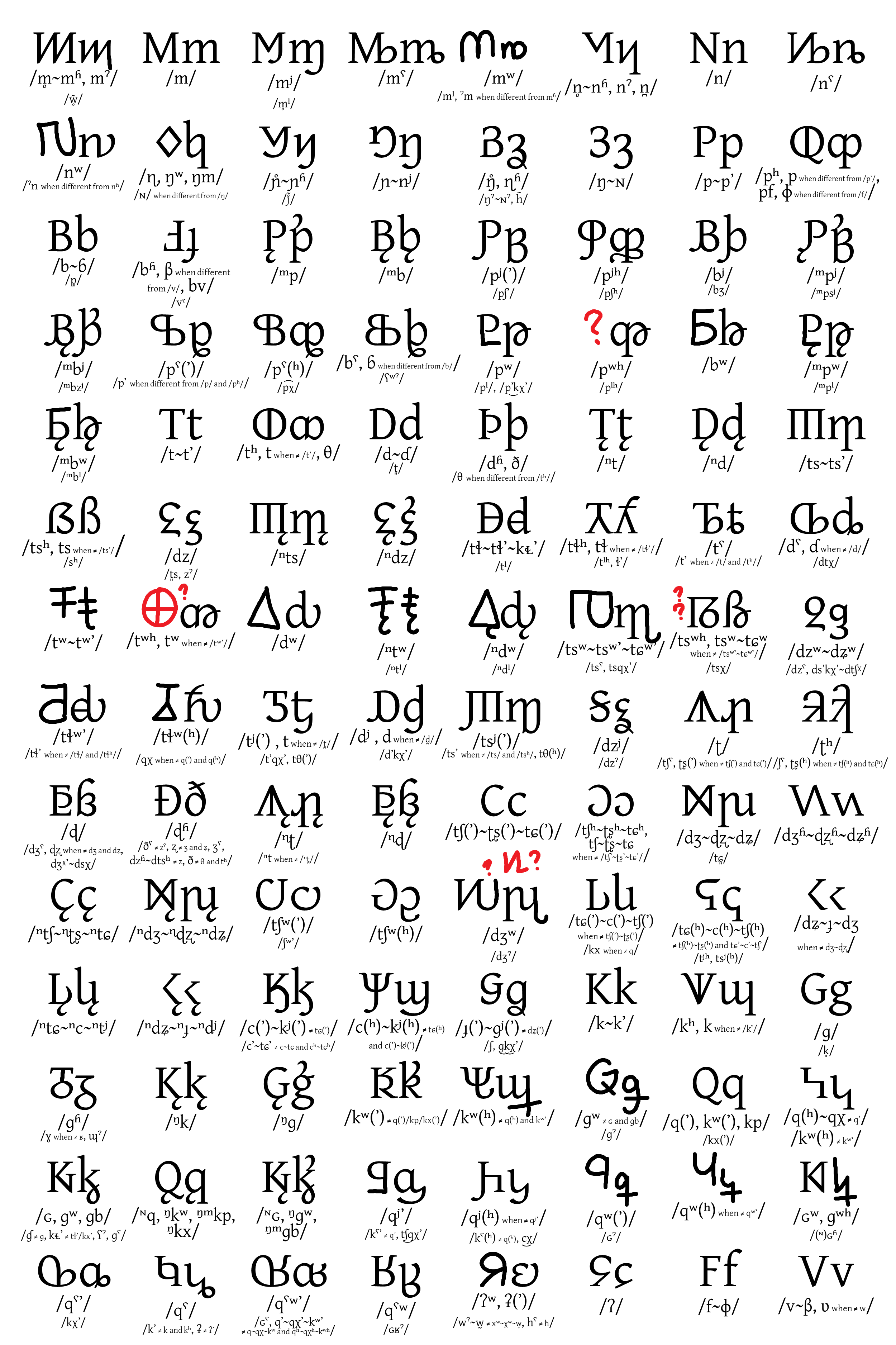
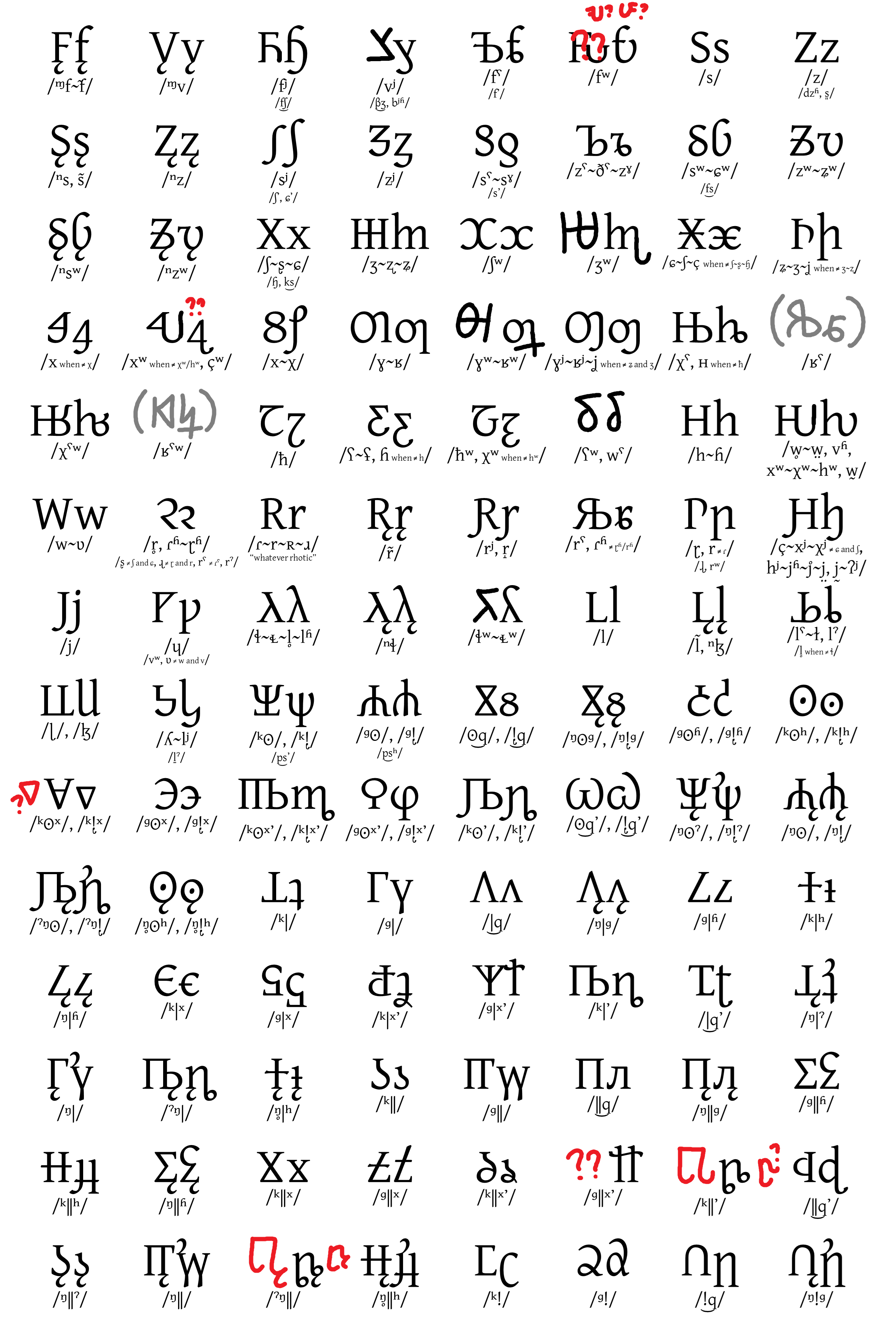
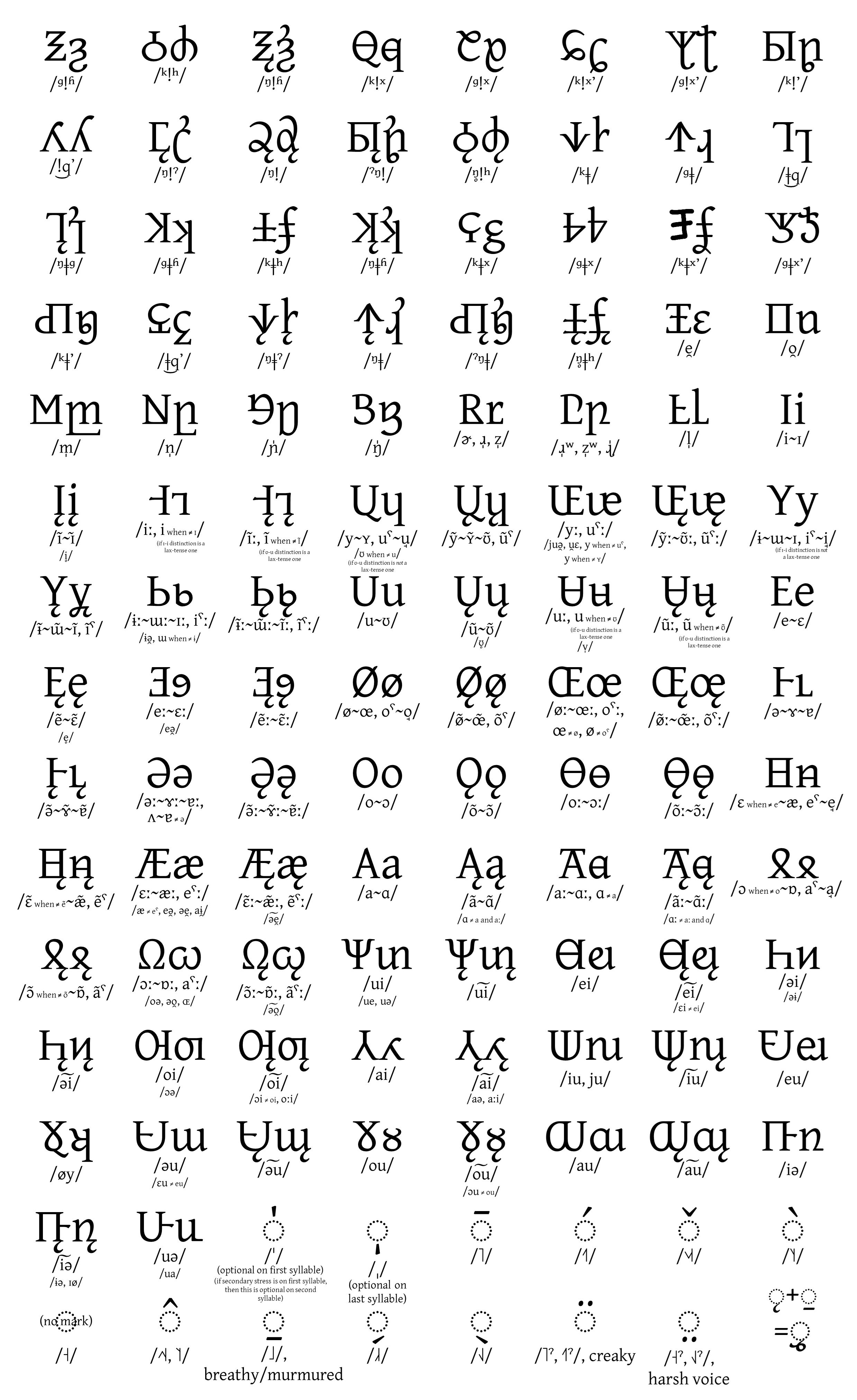
Sorry it's just crummy drawings/editing, this is just concepts for the ideas, not finalized.
Yes, two (very rare) letters would be removed and replaced with other letters.
OLD VERSION OF MBEARPHABET
The version of Mbearphabet shown above is v2. The old v1 is below.
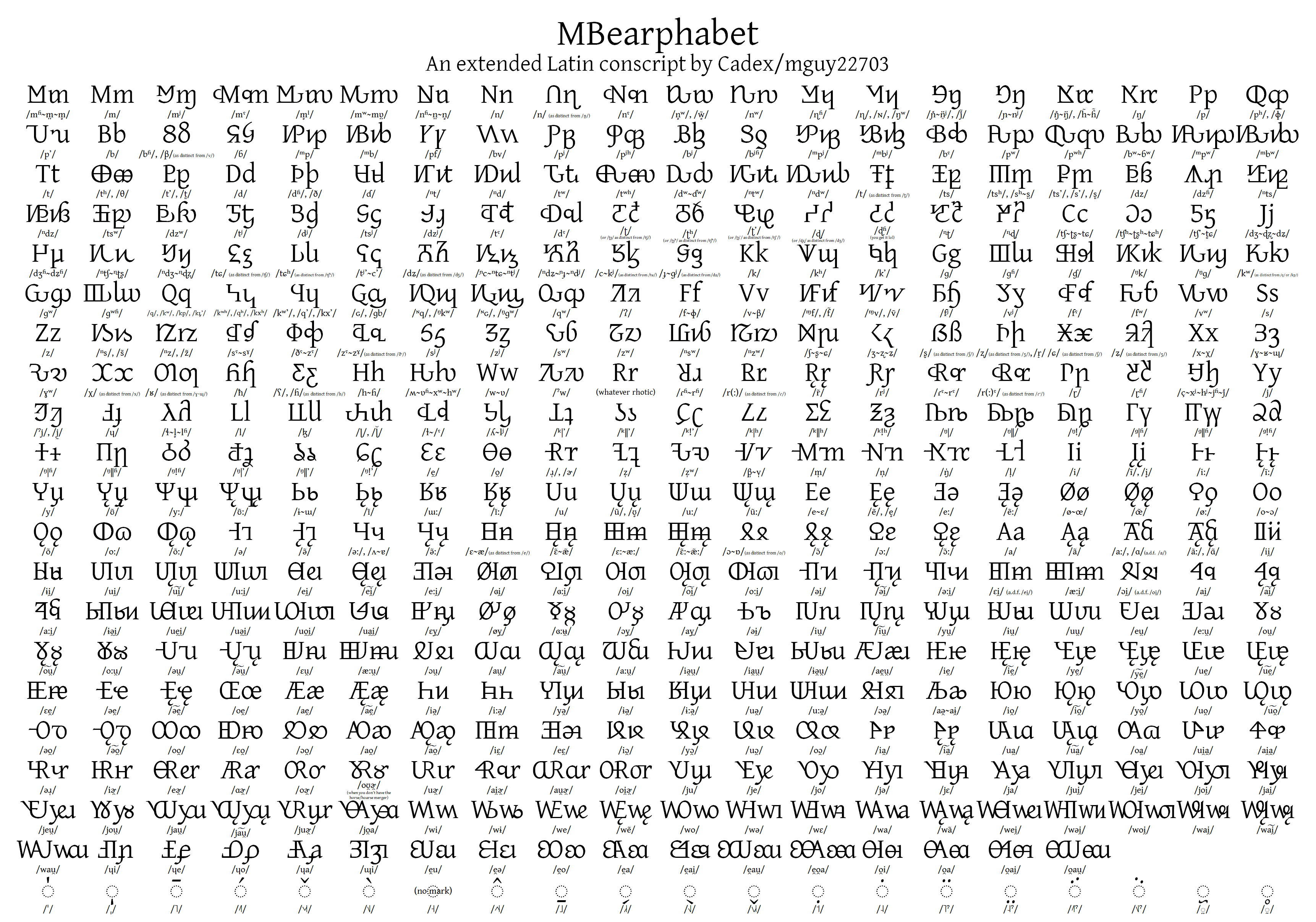
As you can see, it's kind of...a mess. Lot of ugly letters and the only reason there's so many diphthong/triphthong singular letters is because this one person I used to know claimed it was "crucial" for a phonemic orthography for a language to contain singular letters for all of its multiphthongs. (Said person was actually really horrible and has since been cut off but that's off topic.)
This version did have separate letters for ejectives and implosives however, maybe that was better? There are definitely a few decisions here I actually rather like.
This page last updated December 17, 2025.
I WANNA GO HOME I WANNA GO HOME I WANNA GO HOME